SYNCHRONICITY ITSELF
Exploring Carl Jung's Concept of Synchronicity and Its Potential Role in Adult Development
— by Ralph Williams
“Life is full of surprises,” or so it is often said. These words are spoken now and then to remind us that all things change with time and around every bend there always lies the possibility that something new and out-of-the-blue could happen. Expect the unexpected! This phrase is used on occasion too as a clever reminder that unanticipated or unusual events are inevitable, and we should try our best to be braced and prepared for their sudden arrival. Sometimes though, things will occur in life that are so peculiar and ironic that they seem to extend beyond the limits of what we would normally expect, even from the unexpected. Imagine, for example, that you are writing an old friend after years of lost contact, and in the middle of your composition, the phone rings and it is the very friend you are writing. Or, suppose that while driving to work one day you start to sing a few bars from an old musical, and a few seconds later, the song comes on the radio. Most of us have encountered events like these from time to time—events that seem all-too-timely or suspiciously uncanny. It might involve the peculiar way that a helpful person or some much-needed information happens your way as if air-dropped from heaven straight into your lap. It might also occur through a series of events or a chance meeting that seems to redirect a project or career path in a highly fortuitous manner, as if the doors of opportunity were being opened by fate herself. These experiences are typically referred to as coincidences, but are they always pure coincidence?
Chapter 1
Nature of the Phenomenon
Coincidence is no stranger to life, of course, and given that we live in a dynamic world of endless interactions, it would be a bit bizarre if coincidental events never occurred at all. But sometimes, the irony of an experience can be so profound and the coincidence so precise that it becomes difficult to dismiss to mere chance. But if not coincidence, what then? This question has troubled humankind throughout the ages and has given rise to a host of explanations and mythological tales. Ancient cultures with polytheistic beliefs would usually interpret events like these as signs or omens from the gods—something to either be feared or revered depending on the nature of the coincidence. Some would even place an otherworldly instigator behind these events, known as a “trickster“. In Greek mythology, for instance, Hermes is depicted as a mischievous, wing-footed god who moves between the godly and earthly realms, delivering messages and taking pleasure in staging mishaps and surprises for humans. Hermes is also portrayed as the guardian of human boundaries, including those between life and death, waking life and sleep, and the god-realm and humans. Roman mythology has a very similar character in the winged messenger-god, Mercury, who is typically depicted with little wheels under his feet to help him deliver lucky moments and auspicious news quickly. In Norse mythology, Loki is the shape-shifting trickster of the unseen world, and to the Ashanti people of West Africa, it is the god Anansi. In ancient Chinese mythology, the trickster character is embodied in the clever and disobedient monkey, Sun Wukong, while in the sacred mythology of India, it is Krishna. To the Polynesian Islanders, it is Maui, and in the stories of the American Plains Indians, it is typically the trickster Rabbit and Coyote who are placed behind disrupting events and lucky coincidences.
Throughout human history, philosophical and spiritual beliefs also have been called upon to make sense of the unknown. Age-old concepts like fate, destiny, providence, and grace have certainly been used to interpret and frame auspicious events, usually with the idea that nothing in life occurs by accident or coincidence. Religious ideologies, too, have long provided the basis for labeling wondrous events as miracles, acts of divine intervention, or evidence of God’s will and handiwork. But Swiss psychologist, Carl Gustav Jung, had his own theories about these types of events. While not to discount the possibility of a divine agency behind the phenomena, Jung believed that many of life’s coincidences could be attributed, at least in part, to the activities of the human psyche. He also believed that when something occurs in a meaningful way and appears to defy all rational explanation, it moves away from the domain of mere coincidence and into a special category of human experience, which he called synchronicity.

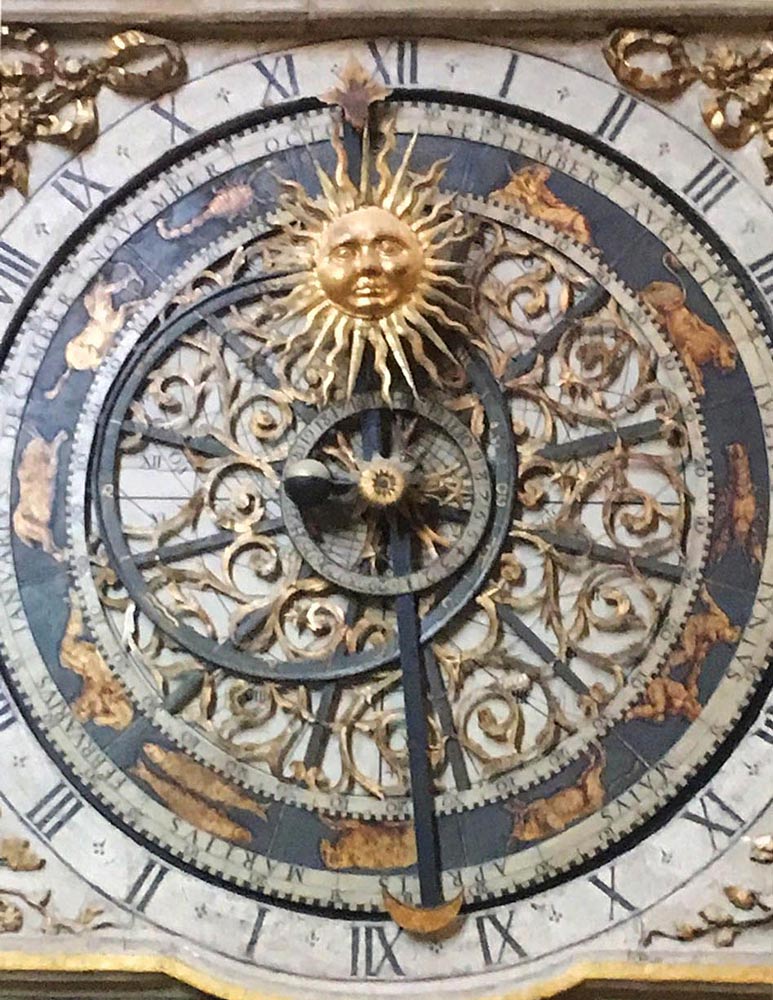
Sunburst over Limousin, France
[Edith Bougon, c. 2019]
Jung's Theory
Jung’s concept of synchronicity is presented in a manuscript that he authored in cooperation with renowned physicist Wolfgang Pauli, entitled, “Synchronicity: An Acausal Connect Principle“. The work was first published in the 1952 edition of Jung’s “Collected Works”, which followed the release of an essay entitled, On Synchronicity, appearing in the 1951 edition of his Collected Works. While Synchronicity was a groundbreaking work in terms of its theoretical contribution, Jung was certainly not the first to theorize about life’s coincidences. In fact, before the release of his manuscript, the issue had attracted the attention of such noteworthy individuals as Arthur Schopenhauer (1891), Paul Kammerer (1919), Wilhelm von Scholz (1924), John William Dunne (1938), and even Albert Einstein (1918), whom Jung credits as catalyzing his thinking on the matter. Jung, however, was the first psychologist to formally define synchronicity and connect it to the human psyche.
While Jung initially became intrigued by the concept of synchronicity in his early twenties, he kept his ideas private for some time. In fact, it was not until 1930, during a memorial address for sinologist, Richard Wilhelm, that Jung publicly used the term synchronicity. Jung gradually became more outspoken on the matter, and during his Tavistock Lectures in London in 1935, he referred to synchronicity as “a peculiar principle active in the world so that things happen together somehow and behave as if they were the same, and yet for us they are not.” Over the years, the concept gathered momentum in Jungian circles, and it soon became a regular part of Jung’s lectures. Finally, in 1949, Jung offered his first full description of synchronicity in the foreword to the Wilhelm-Baynes translation of the I Ching or Book of Changes (1950), although his ideas were still not in manuscript form. In retrospect, it appears that Jung was allowing his thoughts on synchronicity to incubate and mature before officially presenting them. When Synchronicity was finally published in 1951, Jung explained in the forward: “In writing this paper I have, so to speak, made good a promise which for many years I lacked the courage to fulfill. The difficulties of the problem and its presentation seemed to me too great; too great the intellectual responsibility without which such a subject cannot be tackled…”.
Initially, the manuscript was met with great criticism by the Psychology community and became regarded as a controversial work. The problem, aside from the fact that it ran contrary to the deterministic and Freudian-based perspectives of the time, was that it drew into the field of psychology a collection of experiences that many considered reminiscent of superstitious thinking. Jung, of course, was well aware of the sentiments of his time. He even warned his readers in the forward to the book to be prepared to “…plunge into regions of human experience which are dark, dubious, and hedged about with prejudice.” But his intent in writing Synchronicity was not to lend credence to age-old superstitions or condone magical ways of thinking. Quite the contrary, Jung hoped his ideas might clear away some of the mystique surrounding this aspect of human experience. He also hoped his perspectives would provide the foundational thought necessary, as Jung states, “…to open up a very obscure field which is philosophically of the greatest importance.”
Jung came to regard the concept of synchronicity as one that not only pertains to the field of psychology, but physics, philosophy, and religion as well. Recognizing the magnitude of the concept and that his ideas barely skimmed the surface, Jung submitted his synchronicity theory as an incomplete work. It was a beginning nonetheless, and one that he hoped would inspire further study. Over the years, countless theorists have drawn upon Jung’s theory as a reference point for exploring and pushing forward this tenuous and rich area of psychology. However, despite all the assertions, criticisms, clarifications, and elaborations that this work has evoked since its first release, Synchronicity: An Acausal Connecting Principle by C. G. Jung, still remains the preeminent theoretical framework for understanding synchronicity.
Synchronicity vs Coincidence
Perhaps the best way to start describing synchronicity is to delineate how it differs from coincidence. A coincidence, stated simply, occurs when two or more events have some intriguing aspect in common. While the same could be said of synchronicity, a synchronistic experience differs in that it always involves three key components:
- an inner-outer connection
- connection through meaning
- inexplicability
The first element, an inner-outer connection, pertains to Jung’s basic definition of a synchronistic event. Synchronicity involves the process of seeing a connection between an internal event, which is psychological, and an outer event which is observable in the physical world. The internal event may involve anything from general thoughts and ideas, to intuitions, dreams, or an emotional state. The external event may consist of anything that occurs outwardly in life—from conversations or encounters with people, to accidents, discoveries, or experiences with nature. It may even involve something as simple as hearing a single word or seeing a specific object which relates directly to something thought or otherwise experienced psychologically. Synchronicity then involves the observation of a life event that corresponds directly with something in one’s psyche. Stated another way, when something in one’s mind “clicks” with something in the world, this is indicative of synchronicity.

Near Covent Garden, London
By contrast, a coincidence does not require this kind of inner-outer connection. Although a coincidence may involve a psychological component, more often it involves the act of observing an unusual correspondence between two or more external things. For example, a couple on a first date may suddenly realize that they were born on the same day, or two college students comparing schedules for the coming semester may find that they have enrolled in the exact same courses. When interesting parallels like this occur, usually one person will remark, “Wow, that’s weird,” or “What a coincidence!” But this is not the same as experiencing synchronicity, and the difference lies in the fact that these kinds of events do not involve a connection to something psychological.
The second way that synchronicity differs from coincidence is through the presence of meaning. Meaning is essential to synchronicity because it provides the connective link between the internal and external events. Plus, the involvement of an inner, psychological component has the effect of personalizing the experience, which makes it all the more meaningful. Noticing a coincidence, on the other hand, merely involves the act of observing a peculiar correspondence between two or more events, which makes the correspondence more detached from oneself. For example, in the case above with the couple with identical birthdays, the recognition of the correspondence involves the mental act of linking two observable factors together and taking note of their peculiarity. Since there is no internal event, the connection merely becomes an interesting observation. By contrast, consider the experience of thinking about someone right before they call. This differs from coincidence because internal events (thoughts) are personal to us—we own them. Hence, the act of seeing a correlation between one’s private inner world and something in the outer world has the effect of imbuing the whole experience with personal meaning. The issue of “what constitutes meaning” is a key consideration in synchronicity, and it is one that will be addressed in a later chapter. But for now, what is most important is the idea that synchronicity always involves the act of connecting an inner event to an outer one through meaning, and it is through this inner-outer connection that the experience gathers significance and pulls away from coincidence.
The third condition that separates coincidence from synchronicity is inexplicability. According to Jung, for an event to be considered true synchronicity, it must arise in some highly illogical fashion, as if the experience was somehow able to slip by or override the traditional laws of cause and effect. For instance, imagine that a man dreams that he wins the lottery by selecting six numbers, and the next week, he plays his dreamt numbers and he wins. An incident like this would appear to defy all logical explanation—not because of the odds against hitting all six numbers, although this is indeed out of the ordinary—but because he dreamt of the numbers beforehand. By the traditional laws of causality, life unfolds in a linear, sequential fashion (A + B + C = D) with every event being caused by a preceding event or chain of events. So how would it be possible for someone to see or know of something before it happens? This indeed is one of the questions that synchronicity raises. And while there are certainly other ways that an experience can appear inexplicable, aside from the “out-of-order” type depicted here, as a general rule, a synchronistic experience will appear inexplicable when it involves an inner-outer correspondence that, from all angles, has no causal grounds for being there.
Causality is something that becomes so deeply ingrained in one’s thinking that it is rarely given a second thought. When a ball is kicked, it moves. When we strike a match, it ignites. As Newton’s Law explains, with every action or cause, there is a necessary and sufficient reaction which immediately follows. This law is the essence of causality. But causality is not something that is learned through a course in physics—rather, it is an understanding that is acquired instinctively and necessarily through the course of life. As Piaget (1957) explained, the human mind has an inherent need to understand and anticipate the activities of the world, and since the world operates by certain consistent principles of cause and effect, it is through the process of observing the world, which begins at the onset of life, that we humans come to view events as always unfolding in a logical, linear fashion. This “strictly causal” view of the world is strongly reinforced in our minds in childhood through the lessons we receive at school and at home, and through the messages we hear and internalize through our culture. We begin placing our faith in causality very early, and as this knowledge is tested and develops over time, it becomes a basis for understanding reality. This is why an encounter with synchronicity can have such a jarring effect—because it calls into question our basic understanding of how the world works. Invariably, some confusion and grappling will follow a synchronistic experience as one searches for explanations and uses norms to judge the probability of the occurrence. But if the experience is truly inexplicable, it will not be easily reconciled through the mind’s traditional model of linear causality.
A coincidence, on the other hand, does not usually have this kind of unsettling effect, nor does it trigger a search for explanation. In general, to judge an event to be a coincidence involves the act of attributing some logical cause or explanation to the event, despite the fact that the real explanation is unknown. For example, when a person says, “Oh, it’s nothing but a coincidence,” this essentially means that the person has assessed the overlapping events and has come to the conclusion that while there may be an interesting connection or parallel between them, there is no real need to search for a reason behind the occurrence. In essence, the label of coincidence provides the explanation. An experience of synchronicity, on the other hand, is much more difficult to dismiss. This is largely because it involves a psychological component, and it is difficult to lend a rational or causal explanation for why something psychological would coincide with something physical. It simply runs contrary to what we know to be true. So with synchronicity, the traditional laws of cause and effect are generally found to provide an inadequate means for even speculating on a possible explanation. In summary then, the act of labeling an experience as a coincidence is one where a logical explanation is presumed to exist somewhere, whereas an experience of synchronicity leads to the sense that no logical explanation is available anywhere.
There are times, however, when an experience will resemble synchronicity despite the fact that it does not display a clear-cut defiance of causal laws. These kinds of experiences create a gray area for synchronicity because they are based more on improbability than inexplicability. For example, imagine that a woman flies to New York City to surprise an old friend, and upon arriving, she stops at a local market for a newspaper where, ironically, she bumps into her friend. Clearly, the chance of this happening would be extremely low, but the occurrence does not lie outside the realm of possibility in terms of causality. Since there is nothing blatantly out of sequence here (as with the previous lottery example) and since the internal factor is less pronounced, their meeting could just be a fluke occurrence. Nevertheless, the odds of the event occurring are highly unlikely, and it is the recognition of this fact that draws attention to the event in the first place. While causality has to do with “the way things happen in life,” probability has more to do with the way we would expect things to happen, or the way that our minds imagine things should happen. Consequently, with events that appear improbable, instead of wailing a direct assault on one’s causality model, these events will simple appear unusual with respect to the laws of probability. There are, of course, degrees of probability, and the degree to which an experience appears improbable will or may affect the way that the observer assesses the experience. For instance, in the example cited above, if the local market was within a few blocks of the friend’s house, the meeting becomes easier to reconcile. However, if the meeting takes place in a small out-of-the-way market on the outskirts of the city, the improbability is much higher and it is in cases like these that it can be difficult to dismiss the incident as mere coincidence. This is where the issue of inexplicability gets tangled up with probability, and it is also here that the concept of synchronicity opens itself up to debate.
Psychologist Charles Tart once made the comment that events sometimes masquerade as synchronicity in the sense that they appear incomprehensible on the surface, but have causal roots nonetheless. So how are we to know the difference between the improbable and the inexplicable? Well according to Tart, “…absolute synchronicity occurs when no causal mechanism could have been responsible.” Or as Jung once said, “…their ‘inexplicability’ is not due to the fact that the cause is unknown, but to the fact that a cause is not even thinkable in intellectual terms.” But this raises the question of how to regard the term “unthinkable” since what may be unthinkable to one person may not be unthinkable to another. And to be honest, even Jung himself cited examples of synchronicity that are within the realm of probability. Nevertheless, the condition of inexplicability is a necessary one because it elevates the standard of what is to be considered synchronicity, and it implies that before an experience is to be identified as synchronicity, all avenues of logical explanation must be explored thoroughly.
Carl Gustav Jung, c. 1960
[public domain]
The Matter of Time
The term synchronicity is actually a good one because it reflects the irony that typically surrounds these experiences, as well as the idea that the inner-outer events will appear to fit together like synchronized gears on a clock. Synchronicity, however, is not always synchronized. To say that something is synchronized, like synchronized swimmers or synchronized watches, literally means, “happening or existing at the same time” (Oxford American Dictionary, 2021). But with synchronicity, the inner and outer events do not always occur at precisely the same time. Very often in fact, one event will follow the other in time by a minute, an hour, or even by several months or longer. And yet, the events will be connected. For instance, if you have a dream, and the dream becomes eerily reenacted in real life a few days later, the two events will still be linked in spite of the time gap because of the unmistakable correspondence between them. When this occurs, the lack of synchrony in the situation becomes irrelevant because it is their connection through content and meaning that binds them. This type of synchronicity is evident in the case of Rosalind Heywood (Henry, 1993). Heywood reported that once while flying in an airplane, she found herself contemplating a particular poem portraying wasps in a positive light. Then later, as she was exiting the plane, a swarm of wasps gathered above her head and hovered there for some time, as if her previous thoughts had somehow summoned the wasps to her. Ironically too, Heywood was not stung, which only reinforced the correspondence between her previous thoughts about good wasps and her experience exiting the plane.
According to Jung, when synchronicity involves some lag time between the psychological event and the physical event, the experience should be designated as synchronistic rather than synchronous, since it does not occur in a synchronous manner. This is not to say that the timing of events is not critical in some cases. Indeed, synchronous synchronicity does occur, and the case of Judy Vibberts illustrates this well. While relaxing one day at around 4:30 in the afternoon, Vibberts was suddenly struck with excruciating abdominal pains, followed by a splitting headache. Then later that evening, Vibberts discovered a dear friend of hers had been in a serious car accident at around 4:30 in the afternoon, suffering injuries to the abdomen and head (Bolen, 1979). In this case, Vibberts’ experience in the park (which was both physical and psychological) corresponded directly to her friend’s accident, thus creating synchronous synchronicity. Events like these that are woven together and join by time gather meaning simply through their uncanny overlap.
Summary
Synchronicity has been defined as a rare human experience that differs from coincidence through the presence of an inner-outer connection, meaning, and inexplicability. While these three elements contribute important pieces to the phenomenon, individually, they do not function as independent factors. On the contrary, they are interrelated, and as such, they can gain prominence and intensity through their relationship to one another. For instance, the more precise the correspondence between the inner and outer events, the more meaningful and inexplicable the event will appear. Similarly, the more poignant and precise the meaning in the experience, the more inexplicable the event becomes—or conversely, the more inexplicable the event appears, the more it gathers meaning. It is also important to recognize that while the timing between the inner and outer events can often act as an intensifying agent, as with synchronous synchronicity, in many cases, the timing of events will be relatively unimportant because of the binding quality of meaning.
Finally, because synchronicity is an inexplicable event that defies the laws of causality, it often will evoke a temporary state of confusion in the observer. This state of disequilibrium and the ensuing quest for a logical explanation is largely driven by the instinctual human need to understand, anticipate, and feel secure in the world. The issue of inexplicability, however, is a tenuous one because the act of determining what is inexplicable or unthinkable is relative to the individual. This is particularly true when it comes to experiences that are highly improbable but do not completely defy the laws of causality. Fortunately, Michael Fordham (1957) offers some clarity in this area. He explains that what is most important in synchronicity is that the individual believes that a cause has been undermined and that they feel something special has happened to them. Fordham may be a bit lenient here, but his sentiment is a good one. Because of the peculiar nature of these experiences and because there are degrees to which all three factors may participate in any given experience, it would be impossible to draw a line distinguishing where coincidence ends and synchronicity begins. In reality, there exists some kind of continuum between them with common coincidence on one end and mind-blowing synchronicity, as with a miracle, on the other. And while the condition of inexplicability may help draw a theoretical distinction between coincidence and synchronicity, ultimately it is up to the individual to interpret the nature and significance of their experience based upon what they observe about it on an objective level, and what it means to them on a personal level.

Boston Public Garden, 2018
Chapter 2
Forms of Expression
While synchronicity can appear in an infinite number ways depending on the life of the individual, there are some geneal forms that it tends to take, and this allows us to create some groupings for better understanding it. In the early 1990s, British researcher Jane Henry conducted an extensive study based on a survey-questionnaire to discover the different ways that people experience coincidences. While Henry’s study is designated as a coincidence study and not a synchronicity study, Henry prefaced her report with a definition of coincidence that closely resembles Jung’s idea of synchronicity. She asserts, “A coincidence experience may be defined as the occurrence of two (or more) odd, surprising, out-of-the-ordinary, or personally meaningful events connected in the mind of the observer.” After combing over 1,000 questionnaires, Henry found that coincidences are typically experienced in the following ways:

Graffiti detail―Zürich, Switzerland
- Spontaneous associations (reported by 75%)—thinking of someone before they call, etc.
- Small world encounters (66%)—highly improbably meetings with people
- Cluster experiences (50%)—recurrence of a name, number, or theme
- Paranormal encounters (40%)—includes telepathy
- Helpful or hidden hands (40%)—the sense that events are being guided
- Library angel (33%)—books or information appearing mysteriously
- Guardian angel (30%)—the sense of being protected by unseen forces
- Prayers answered (30%)
- Recovery of lost property (29%)
- Psychokinesis (25%)—moving objects through mental effort
- Other (16%)—omens, warnings, and fortuitous accidents
[Since Henry's survey-questionnaire appeared in a newspaper and most likely attracted respondents who were already curious about coincidences, these results should be regarded more as a general guideline than an unbiased polling of the population]
Parapsychological Forms
As Rhine and Pratt (1956) explain, to call a phenomenon parapsychological means that it “…has been shown by experimental investigation to be unexplainable wholly in terms of physical principles…” and requires, “…a mode of perception that is independent of the senses.” These kinds of events include telepathy (mind-to-mind communications), precognition (the act of seeing future events as with dream premonitions), clairvoyance (to see or sense an event at a distance of space or time), déjà vu (the uncanny feeling of having experienced something before), and psychokinesis (to demonstrate mind over matter, as with bending a spoon with the mind). Jung (1960), Bolen (1979), Von Franz (1988), and Progoff (1973) agree that these types of events, which are generally referred to as psi phenomena, fall within the synchronicity family because they involve an inner-outer connection and because their occurrence is inexplicable. In fact, most synchronistic experiences involve a parapsychological component of some kind. For instance, when an individual has a dream that predicts some future event in life, the occurrence is indicative of precognition. Likewise, when an individual suddenly feels that a loved one has been injured at the very moment that they’ve suffered a car accident, it suggests that some form of telepathic communication has occurred between them. But should psi-phenomenon be regarded as meaningful? For example, should the act of bending a spoon through mind-power be regarded as a meaningful experience? Perhaps not, although it could be argued that the experience gathers meaning through its inexplicability.
This becomes less of an issue with everyday synchronicity since most of these occurrences involve a meaningful and self-evident connection to an aspect of the observer’s life. But, even without these types of personal connections, it’s hard to imagine that a person could experience psychokinesis or otherwise and render it meaningless. Perhaps a gifted test subject could perhaps grow so accustomed to performing a task that it becomes meaningless to them—but other than that, synchronistic experiences involving psi tend to leave an indelible impression on the observer and may even prompt them to rethink what is humanly possible.
Repetitive Forms
Synchronicity can involve encountering a name, number, object, or idea, over and over again within a short time span (called as cluster experiences in the Henry study). As a case example: a male graduate student once had the uncanny sense that he was surrounded by the number thirteen. According to the student, the number kept popping up on store receipts, parking garage tickets, and even books would fall open to page thirteen. The young man did not regard the pattern as an omen of bad luck—he simply had the sense that the number was following him. He tried to ignore it and dismiss it as nothing for a while; but then, as he explains:
“I was riding the bus one day, just like any other day, and when I looked up, I noticed I was on bus #13. So of course, I was immediately reminded of my number series. I looked around, and I noticed that a digital counter of some kind above the bus driver was stuck on thirteen. I then took a quick head count of passengers and found that, sure enough, counting myself there were thirteen people on board. Even the guy sitting across the aisle from me was wearing a jersey with the number thirteen on it. I tried to convince myself that it was just a fluke and that the number was showing up because I was looking for it. But then, I heard a woman at the front of the bus ask the driver, ‘Could you please let me off on 13th Street? It was just one thirteen too many.” [2008 interview]
This makes for an intriguing story, but we have to wonder, was the student seeing thirteens because he had noticed them before and had become sensitized to seeing them again. As Gardner (1972) writes, “The number of events in which you participate in for a month, or even a week, is so huge that the probability of noticing a startling correlation is quite high, especially if you keep a sharp outlook.” This would certainly explain why the young man took notice of the bus number in the beginning, but should so many thirteens be aboard one bus, even if he was on the lookout for them? It is here that it becomes difficult to distinguish between random coincidence and true synchronicity. Coincidence enthusiast, Arthur Koestler (1972) believed that when repetitious patterns appear in life, it is often more than just random, but instead is an expression of a creative tendency in nature. Said Koestler, “We thus arrive at the image of a world-mosaic or cosmic kaleidoscope, which in spite of constant shufflings and rearrangements also takes care of bringing like and like together.” Likewise, Paul Kammerer (1919) viewed nature as having an inclination toward pattern-making, which he called the law of seriality. Kammerer imagined this principle operating something like a gravitational force, drawing like events together or perhaps conditioning them so that they develop a natural affinity for one another. This theory aligns with the modern idea of a universal law of attraction, where like attracts like and the energetic quality of one’s thoughts attract similar events, whether positive or negative.
While Jung found repetitious events curious and worth exploring, he held that what separates synchronicity from repetitive expressions is the presence of a connecting psychological component. What’s more, Jung’s concept of synchronicity requires inexplicability, and most repetitious events will not meet this condition if the role of chance cannot be ruled out entirely. At the same time, Jung (1960) recognized that repetitive occurrences will often have a strong synchronistic quality to them, which he experienced in his own life through series of encounters with fish. As he recorded in his journal:
“On April 1, 1949, I made a note in the morning of an inscription containing a figure that was half man and half fish. There was fish for lunch. Somebody mentioned the custom of making April Fish of someone. In the afternoon, a former patient of mine, whom I had not seen for months, showed me some impressive pictures of fish. In the evening, I was shown a piece of embroidery with sea monsters and fishes in it. The next morning, I saw a former patient who was visiting me for the first time in ten years. She had dreamed of a large fish the night before.”
Ironically, just as Jung was documenting this, he walked over to a spot by the lake in front of his house and spotted a large dead fish on the sea wall. Said Jung, “Since no one else was present, I have no idea how the fish could have got there.” But then, in assessing his fish series against his own definition of synchronicity, Jung states, “So there is no possible justification for seeing this as anything but a chance grouping. Runs or series which are composed of quite ordinary occurrences must for the present be regarded as fortuitous” (happening by chance). Jung’s assessment here seems reasonable, but there is one more facet to consider. The fish were appearing at a time when Jung was researching the history of the fish symbol, so his head was already swimming with fish. On the surface, this would seem to suggest that Jung’s focus on fish had sensitized him to seeing them. But is it also possible that Jung’s fish concentrations somehow created a hospitable environment for the fish to appear? Was the outer world mirroring his inner world? Hard to say, but the fact that fish were already on his mind adds a psychological element which in turn, draws the event chain closer to synchronicity.
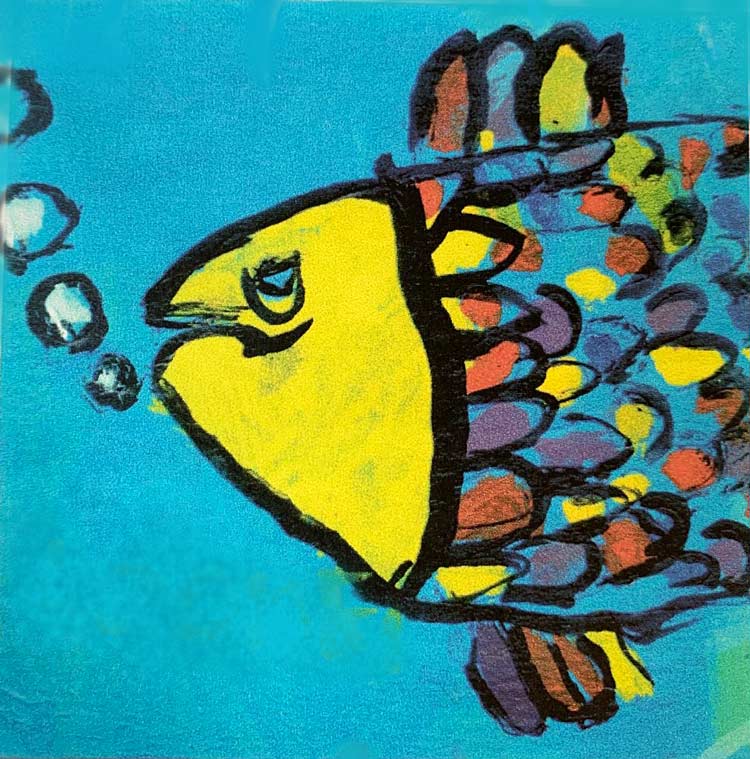
Painted in tempura by an unknown grade school artist in Mexico
Jung took a firm stance of the condition of inexplicability, most likely to protect his theory from misinterpretation and misuse. But this by no means suggests that all events that do not meet this condition should be discarded to the coincidence pile. As Jung states, “Meaningful coincidences are thinkable as pure chance. But the more they multiply and the greater and more exact the correspondence is, the more their probability sinks and their unthinkability increases, until they can no longer be regarded as pure chance but, for lack of a causal explanation, have to be thought of as meaningful arrangements.”
Jung's Classifications
While synchronicity can be experienced in countless ways—as psi phenomena, uncanny meetings, repetitious events, spontaneous associations, and so on—Jung viewed the phenomenon as falling into the following three general categories:
- A coincidence of psychological contents [thoughts, visions, and emotions, unconscious drives] with a corresponding external event where there is no evidence of a causal connection between them and such a connection is inconceivable
- A coincidence of psychological contents with a corresponding external event taking place at nearly the same time at a distance outside the observer’s field of perception and the event is later verified
- A coincidence of a psychological contents with a corresponding future event, which is later verified

The first category in Jung’s list involves the near-simultaneous connection between the inner and outer events, sometimes referred to as synchronous synchronicity. Jean Bolen (1979) offers a nice anecdotal example of this type in an incident involving her 4-year old daughter. She writes: “I was in the kitchen in the midst of a dinner preparation and I mentioned to my husband Jim that I needed some flowers for the table. The children were playing outside, quite out of range of hearing. Moments later, Melody came in through the length of the house, a bouquet of pink geraniums in her hand, saying, Here, Mommy!” While not entirely inexplicable, this sweet example demonstrates the how Category-1 synchronicity can show up in everyday life. And while there was a brief gap in time between Bolen’s thoughts about flowers and the flower delivery, the gap is not critical here. The fact is, Jung’s qualification of “nearly-simultaneous” in the second category should probably be added to the first category to loosen up the criteria some.
Here is another good example of this type of synchronicity, provided by S. Kelly: While walking one evening with her good friend Greg, Kelly began thinking and talking about an uncle she had not seen in years but knew lived in the area. As the couple turned at an intersection, Kelly was approached by a man who asked her if she had the time. Ironically, it was her uncle. Meanwhile Greg, while looking into the man’s face, was reminded of his friend Roland. Ironically again, as the couple proceeded down the street, Greg spotted Roland heading their way.
Since this type of synchronicity involves the simultaneous or near-simultaneous occurrence of events, the observer will invariably see the connection right away. As such, events that fall into this first category can be characterized as simultaneous (more or less) with an immediate sense of synchronicity. The second form of synchronicity Jung outlines differs from the first in that the corresponding outer event lies outside of the observer’s immediate view, and as a result, the synchronicity is not discovered until a later point in time. The psychological event in these experiences will usually consist of a vision, dream, or strong intuition. Jung discusses this type of “delayed synchronicity” by way of the 18th Century Swedish theologian-philosopher, Emanuel Swedendborg, who once had a fire vision. Jung (1960) writes, “When, for instance, the vision arose in Swedenborg’s mind of a fire in Stockholm, there was a real fire raging there at the same time, without there being any demonstrable or even thinkable connection between the two.”
This type of synchronicity is also evident in a case-example provided by Stiffler (1993) involving an adult woman, adopted as a child, and her biological mother. The woman writes: “I am an adoptee who found some of my maternal family ten years ago. My birthmother was deceased by the time I found them. One of the first things I asked was, ‘When did she die?’ I could not wait to go home to see if I had written an account of it in my journal. The dates were indeed the same. I remember that day very well, and I wrote in my journal, ‘I feel someone close to me has died.’” Here, the external event of the mother’s death was sensed intuitively on the exactly day it occurred—a simultaneous connection that was verified ten years later.
Consider too, the case of Michelle. While taking a bath one evening, Michelle was suddenly overcome by feelings of sadness combined with nostalgic thoughts about her grandmother, whom she adored. She looked up, turned her head towards the door, and as she recalls, “I felt the presence of my grandmother pass over me.” After a fitful night’s sleep, Michelle was awakened the next morning by a phone call informing her that her grandmother had unexpectedly passed away in the night, at the exact time of Michelle’s episode [interview, 2004]. In this case, Michelle’s feelings and thoughts about her grandmother corresponded almost simultaneously with her grandmother’s death, and this correspondence was not discovered until the next morning. Clearly, because this form of synchronicity involves a connection with an outer event occurring at a distance, it is the act of hearing the news of the corresponding event that brings the synchronicity into awareness. Events that fall into this second category may be characterized as: simultaneous (more or less) with delay of verification.
Finally, Jung’s third form of synchronicity pertains to the act of seeing future events, whether through a dream, vision, or clairvoyance. Since the psychological component in this type will always involve a precognitive ingredient, events of this kind will always be parapsychological. With these experiences, too, the corresponding outer event will either be witnessed by the individual in the future or discovered through news of the event. Robert Johnson (1989) offers a case story which illustrates this well, summarized below:
A woman dreamt one night of seeing herself in a secluded area of a monastery which was connected to a chapel. It was a good dream, one rich in symbolism and meaning. The next day, while driving with a friend, she passed a monastery which, coincidentally, the friend had special privileges including a gate key. As the two entered the grounds, much to the woman’s surprise, it was the same monastery and chapel she had dreamt of the night before, in every detail.
With experiences like these, the person must eventually connect their premonition to a real world manifestation of it in order for synchronicity to occur. Very often, though, this does not happen because the person never witnesses or learns about the matching event. Case in point: Abraham Lincoln had visions of his seeing his body in a deathlike state just prior to his assassination, but for obvious reasons, he never actually saw the real-world manifestation of it. A similar example of this may be found in a weird case involving the writings of Edgar Allen Poe. In one of his stories, Poe tells the tale of three shipwreck survivors who, in order to survive, cannibalize a cabin boy named Richard Parker. Fifty years later, well after Poe’s death, the eerie tale grew even more bizarre when a murder trial surfaced involving three shipwreck survivors accused of killing and eating a cabin boy named Richard Parker. Honestly, it is hard to fathom how something like this, where life not only imitates art but matches it directly, could ever come to pass. But it appears that somehow in Poe’s creative process, he managed to channel an event that would transpire in the future. Clearly, Poe died before his creative work was reenacted in real life, which illustrates the point here: for coinciding events involving visions and premonitions to be regarded as synchronicity, in Jung’s view, the person must at some point have the opportunity to see the connection for themselves.

St-Aurelianus Chapel, Limoges, France, 2018
[For illustrative purposes only and not the actual chapel in the case example]
Premonitions can take many forms and sometimes they can take years to materialize and reach fruition. Take for example the legendary premonitions of the late Oglala Sioux medicine man, Black Elk. According to Native American history, at age nine, Black Elk fell ill and experienced an elaborate vision of future strife for the Sioux Nation. Many parts of Black Elk’s vision were realized in the years that followed, and more would come to pass before his death in 1950. Some have even speculated that Black Elk’s vision is still unfolding. So although premonitions tend to correspond to an event in the not-so-distant future, they may also unfold at a significantly later point in time. A lengthy delay of verification may also occur within Jung’s second category of events, as is revealed in the case of the “mother-daughter connection” which was confirmed ten years later. To summarize then, events falling into this latter third category may be described as non-simultaneous with a delay of verification.
Jung’s 3-part framework reveals quite clearly that synchronicity can either be experienced immediately or at a later point in time. It also conveys the idea that the internal and external events may occur more or less simultaneously (Categories 1 and 2) or not simultaneously (Category 3). But the question remains, what if a synchronistic event occurs, and the person notices that something peculiar has happened, but does not put the pieces together until later? Synchronicity has been known to occur like this, but Jung does not account for it. Consider the case of Roger, summarized below, where a foolish accident caused him to recognized synchronicity at a later point in time:
While relaxing at a swimming pool one afternoon, Roger decided to hop in to cool off, and he jumped into the water feet first. After coming to the surface, he immediately heard a whistle, and when he looked over at the lifeguard, the lifeguard hollered, “DON’T DIVE!” “I didn’t,” Roger replied in defense. “NO DIVING!” the lifeguard reinforced. Hours later, as the incident continued to nag at Roger, he thought to himself, “I jumped, how could the guard have seen otherwise?” Roger joined up with a few friends later that evening for a swim in a different pool, and without thinking, he dove into the shallow end, which had a depth of about one foot. Roger miraculously escaped serious injury, but as his head was being stitched up in the emergency room, he recalled the foreshadowing words of the lifeguard—“DON’T DIVE!”
Was this a warning from the unseen world? It is impossible to know, but if it was a warning from a guardian angel speaking through a lifeguard, the message did not register until hours later. For the most part, experiences like these which involve a delay in recognition will only pertain to Category 1 experiences since the other two forms (remote viewing or seeing into the future) will invariably be recognized in the moment the reenacted event is witnessed or news of its occurrence is learned. Events of this kind might be added to Jung’s list and described as: a simultaneous or non-simultaneous coincidence of psychological contents with an external event and the connection is not recognized until a later point in time.
Other Types
In addition to the types mentioned and described so far, synchronicity may assume a positive, negative, or neutral form, depending on the quality of the meaning conveyed. Positive synchronicity tends to arise in situations where a helpful person, opportunity, or some desired information unexpectedly arrives, sometimes in the nick of time. The English writer Horace Walpole coined the term serendipity to describe experiences like these that are helpful or useful and which often arise while searching for something else. Librarians and avid library users know this form well. Consider the curious case of librarian Lois Horowitz (Daniel Liestman, 1992) who, while hunting in a card catalog, found the perfect book for the subject she was researching, and then noticed that the card preceding it offered a precise reference to her next, altogether different, subject. Said Horowitz,“It was the very book I needed to answer my question, and by pure chance—luck, you might say—I found my resource for the question I hadn’t yet begun researching.” Another interesting case of library serendipity was reported to Arthur Koestler by Ame Rebecca West (cited in Combs & Holland, 1990). West said, “After hours of search, I went along the line of shelves to an assistant librarian and said, ‘I can’t find it, there’s no clue, it may be in any of these volumes.’ I put my hand on one volume and took it out and carelessly looked at it, and it was not only the right volume, but I had opened it at the right page.”

Geneva, Switzerland, 2018
Sometimes an event will quickly be deemed positive when it involves an escape from something negative. For instance, on April 19, 1995 in Oklahoma City, a young man who was scheduled to meet with Social Security personnel that morning, upon waking, decided to cancel his meeting for another day because it “seemed like the right thing to do.” As a result, he was safely at home and not inside the federal Murrah Building when the bomb went off around 9am. Life is full of lucky breaks and narrow escapes—this we know. But when synchronicity takes an auspicious or even life-saving form, it can leave its recipient with the impression that God or a guardian angel must be behind it. This same feeling can arise when a chance meeting or an uncanny chain of events redirects one’s life in a positive way, as if a destined path is being forged by unseen forces. This idea is quite similar to the Christian concept of prevenient grace which proposes that the hidden hands of God are always clearing a path ahead of the actual event of life. “Be bold and mighty forces will come to your aid,” as Goethe famously said. But is this true, are unseen forces really guiding and supporting us according to a higher plan? No one knows for sure, but what is most important for our discussions here is the idea that when a lucky break occurs, we will often assign a higher purpose to it. Answered prayers fall into this category, too. Certainly the act of praying creates a psychological component, and as Archbishop William Temple stated, “…when I pray, coincidences happen; when I don’t, they don’t.” Events that involve spontaneous healings of the body, as with the disappearance of cancer, could also be regarded as a special form of synchronicity. Then again, since the mind-body connection is undeniable and the outer event in this case would involve the changes occurring in one’s own body, this territory becomes tenuous. Nevertheless, if the healing is relatively inexplicable and appears to be in direct relation to one’s prayers and willful intentions, it would be hard not to regard it as a wondrous form of synchronicity.
Not all synchronicities are uplifting or benevolent, however, and this is most evident in cases in which a premonition of an accident comes true. It may also involve irritating or frustrating experiences, such as boarding a plane to Timbuktu and being seated next to your arch enemy. And while many synchronicities take on a positive or negative tone, some will assume a very neutral form. Consider the case of Luis Alvarez (Falk, 1981): while reading the newspaper one day, Alvarez fixated on a particular phrase that led him to start thinking about someone in his youth. A few moments later, he turned the page and noticed an obituary for the very person he was thinking about. While admittedly, this example has a somewhat somber quality to it, the experience had neither positive nor negative ramifications for Alvaez and is therefore fairly neutral.
Finally, while synchronicity may be experienced in any number of ways and may arise at any time, there are certain psychological conditions that are believed to be conducive to it. Jung, Progoff, Von Franz, Fordham, Bolen, and others have found that synchronicity tends to be on the rise when two conditions are present:
1) an activated psychological state
2) a critical life period
An activated psychological state usually involves strong emotions, such as anger, love, desperation, determination, fear, desire, and intense interest. Individuals suffering from schizophrenia and manic depression will often report synchronistic experiences, and according to Von Franz (1988), it is reported most often by individuals in hyper-states just prior to a psychotic break. The second psychological condition, critical period, refers to any life phase involving a major transition, as with the birth of a child, falling in love, marriage, puberty, retirement, and certainly death. A critical period may also involve a career change, a big project, a geographical move, and certainly a major relationship change or break-up. Needless to say, there is a necessary overlap between these two categories since the pressures that arise during critical periods will tend to activate and intensify the emotions.
Anecdotal Dilemma
Synchronicity, by its very nature, does not lend itself well to science. It tends to arise out of nowhere like a message-bearing apparition, and then in a flash, it vanishes without a trace. So how is it possible to study something that cannot be pinned down? In theory, it might be possible to select a group of people who tend to experience synchronicity on a regular basis, and then follow those subjects around in the hope of catching something synchronistic in the act. But this of course would be absurd. It would not only be invasive and tedious, but the cost of conducting such a study would be astronomical. Plus, if something synchronistic did happen to happen, its occurrence would still have to rely on the subjective impressions of the subject.
Science is primarily concerned with the pursuit of objective and verifiable knowledge. It is based on the premise that any real phenomenon of nature is repeatable, and will therefore fit into a spectrum of probabilities. But synchronicity is a rare thing that cannot be repeated and cannot be expressed as a probability. Hypothetically, it might be possible to feed the particulars of a synchronistic event into a computer and have it calculate the likelihood of its occurrence and the probability of its reoccurrence. But aside from this being a big number-crunching guesstimate on the part of the computer, it would reveal little if anything about the intrinsic qualities of the phenomenon. What’s more, synchronicity involves a theme-spotting, connection-making, meaning-giving mental component that science cannot quantify.
This is not to say that science can’t make headway on our understanding of synchronicity. Certain forms of it, in fact, can be brought into the science lab, as with the study of telepathy and psychokinesis. While admittedly, this avenue does not embrace the everyday and deeply personal experience of synchronicity, it is important nonetheless since many synchronistic experiences involve a parapsychological component. In studying telepathy, for instance, parapsychologist J. B. Rhine found that when subjects were placed in lead-lined Faraday boxes, the transfer of information continued to occur. Ultimately, this finding reveals that telepathic or clairvoyance experiences do not involve a process by which information is carried through the air via electromagnetic energy or some other causal means. Rhine also discovered that interest level plays a key role in telepathy and psychokinesis. More specifically, he found that at the beginning of an experiment when interest is high, subjects tend to perform well beyond the range of probability. But as time wears on and subjects grow bored, their performance levels drop considerably. This “decline effect” was frustrating to Rhine since it reduced his recorded performance levels. At the same time, though, it revealed a correlation between interest level and the occurrence of certain psi phenomena. This finding aligns to some degree with the idea that synchronicity tends to occur when the psyche is activated. More specifically, it implies that the mental energy that arises through interest may somehow welcome synchronicity or create an environment that is conducive to it. What’s more, since interest is a related to affect, as Piaget found, Rhine’s finding suggests that synchronicity may be related to the affective side of the mind. This study and others like it are important to the general concept of synchronicity because they explore the mysteries of the human mind as well as the unseen modalities of the world, scientifically. State another way, the field of parapsychology can help to reveal on a scientific level what synchronicity reveals on an individual level—that our inner world and outer world are connected in ways we have yet to understand, and the boundary line that we see between mind and matter may actually be more fluid and open than we think.
Still remaining, however, is the issue of everyday synchronicity, which is difficult to isolate and study through traditional science. However, it can still be studied on some level, objectively. Consider Jung’s approach. Aside from having his own synchronistic experiences to draw upon, his patients would share their experiences with him, and every once in a while a synchronistic moment would pop up in their sessions. As Michael Fordham (1957) states in regard to Jung, “The main bulk of his investigation and indeed the basis for formulating the concept was derived from clinical observation of individual patients.” The fact that Jung’s thinking on synchronicity is based on his personal experiences and therapeutic observations is important because it places his theory on firmer ground. In other words, rather than being based solely on the accounts of others, it finds a foothold in firsthand observations. The point here is that while it might be absurd to study synchronicity by following subjects around, it can be studied in other ways. Jung did so through his practice, as did Bolen, Progoff, and Von Franz. Admittedly, using one’s practice as an observation booth may not be the best means for conducting research, but it nevertheless provides a setting where data can be gathered and where the spontaneous event of synchronicity may occasionally fall onto scientific eyes.
For this reason, scientific inquiry must lean on anecdotal accounts to further its understanding of the phenomenon, even though this is rife with problems. As Ruma Falk points out (1981), “Instead of starting by drawing a random sample and then testing for the occurrence of a rare event, we select rare events that happened and find ourselves marveling at their non-randomness. This is like the archer who first shoots an arrow and then draws the target circle around it.”
Jung (1951) also comments on the anecdotal dilemma by stating, “But, to grasp these unique or rare events at all, we seem to be dependent on equally ‘unique’ and individual descriptions. This would result in a chaotic collection of curiosities, rather like those old natural history cabinets where one finds cheek by jowl with fossils and anatomical monsters in bottles, the horn of a unicorn, a mandragora manikin, and a dried mermaid.” And while researchers like Kammerer, Koestler, Vaughan, and others have contributed significantly to our understanding of the phenomenon through their anecdotal collections, eventually these accounts reach a point of redundancy. And at the end of the day, we’re still left with a host of unanswered questions. Jung recognized this problem and attempted to clear a path out of the anecdotal maze by conducting his own synchronicity study, which he documents in his book. Unfortunately, the results of the study were inconclusive, although Jung did note a correlation between synchronicity and interest level.

Ørsteds Park, Copenhagen
Summary
Synchronicity may involve anything from auspicious meetings to premonitions that come true to times when one’s thoughts suddenly seem to materialize in the world. Synchronicity, too, may involve either a simultaneous or a non-simultaneous correspondence between events, with synchronicity either being sensed immediately or verified at a later point in time.

Ørsteds Park , Copenhagen
Jung outlined the general properties of these occurrences through a 3-category framework which he developed to account for all types of synchronicity. While most types do tend to fall within Jung’s framework, there are special instances when an experience will closely resemble synchronicity, but will nonetheless lie outside the parameters of Jung’s definition. This is true of cases where the connection is not recognized in the moment, but the pieces come together later. This also includes those experiences of repetition where the series or recurring theme seems both meaningful and highly improbable. Then again, Jung’s framework should not be taken in absolute terms, but should be regarded instead as a foundation for understanding and building upon the synchronicity concept. Quite frankly, in considering the infinite ways that synchronicity may enter human experience, it may not be possible to account for all the idiosyncrasies of the phenomenon in one comprehensive model. Jung’s structure, nevertheless, is important because it reduces the vast pool of synchronistic experiences into a manageable form, and it provides a conceptual basis of appreciating the phenomenon.
Chapter 3
Meaning in the Middle
We humans are meaning-seeking creatures. We name, categorize, and assign meanings to everything we see. Even the words we speak serve as little carriers of meaning, helping us to communicate with each other and make sense of the world. But with synchronicity, the meaningful connections that we notice are different from the meanings that we assign to everyday objects and events because a synchronistic event involves content that is shared between the inner and outer worlds. It is the act of recognizing this connection through meaning—meaning that transcends the inner-outer boundary, inexplicably—that makes the event extraordinary and therefore meaningful.
This is all fairly clear in theory, but sometimes the meaningful connections that we see when we actually encounter synchronicity are not so straightforward. There can also be multiple meanings, buried meanings, and meanings that seem to have a higher intent behind them. Plus, for our purposes here, we still need to explore the core issue of what constitutes a meaningful connection.
Admittedly, there is a lot to sort though here, so let’s begin with a few case-examples to illustrate some of the ambiguity we can run into when it comes to the “meaningful connection” in synchronicity. Our first case, offered by Vaughn (1979) and paraphrased below, shows how an event can be meaningful and appear synchronistic even though the psychological component is unknown or uncertain.

Graffiti wall in Siem Reap, Cambodia
Retuning the Favor:
One day while on duty on his motorcycle, patrolman Falby collided into the back of a truck and severely injured his leg. Ultimately, he would have bled to death if it wasn’t for businessman, Al Smith, who stopped to help him and used a necktie as a tourniquet to stop the bleeding. Oddly enough, the two men swapped roles five years later when Smith suffered a severe leg injury in a car accident, and it was Falby who arrived on the scene and applied the tourniquet.
This incident is so uncanny that you would think it was a clear-cut case of synchronicity. But then, where is the psychological component in this equation? Is it possible that Falby had been carrying a deep sense of gratitude and indebtedness toward Smith in the years following his motorcycle accident, and these feelings eventually conjured a second event that would allow Falby to balance the scales? This certainly seems plausible, especially for those who believe in karma. But of course, this is highly speculative, and this is one of the main pitfalls when it comes synchronicity interpretation. That is to say, when certain factors are missing or unclear, it is a natural tendency to try to fill in the gaps though speculation.
Our next case-example, offered by Faulk (1981) and paraphrased below, illustrates how a synchronistic event can acquire meaning largely though its auspicious and inexplicable nature.
Flammarion’s Wind:
One afternoon, while writing a chapter on the force of the wind for his book, “L’Atmosphere”, French scientist and author, Camille Flammarion (1846-1936), had his papers swept up and carried off by a whirlwind. Fortunately, the flyng pages found their way onto a nearby street which was frequented by the publisher’s porter, who often carried Flammarion’s work. Seeing that the pages were Flammarion’s, the porter gathered them up and brought them immediately to the publisher, who then returned them to their rightful and very appreciative owner.
In this case, there is a clear and intruiguing parallel between Flammarion’s research on wind activity and the rise of the whirlwind. The true irony, though, lies in the way that the papers found their way home, almost immediately. Is it possible that Flammarion’s research was protected by something unseen, like a guardian angel? Let’s imagine for a moment that the pages just blew away and scattered thoughout the city, never to return? If it had happened that way, most likely the thematic parallel between the whirlwind and the manuscript would have been dismissed as an unfortunate fluke and that would have been the end of it. But instead, the manuscript mysteriously and expeditiously returned, and it is the unlikely odds of this happening that raises the question of whether something larger or even divine might have been behind it. Here again, we see how all kinds of ambiguity and “possibilities” can surround synchronistic events, especially when we try to determine the hows and whys.
Sometimes, too, a string of peculiar events will appear to be thematically and symbolically connected even though the overall meaning is uncertain, as the case below demonstates:
Carlton and the Goldfish:
Carlton’s life was turned upside down after his teenage daughter ran away from home. She was gone for nearly a year, and it was a very difficult and emotionally-charged time for both of them. But she did return eventually, and about a week later, she gave Carlton two goldfish which he promptly put in his fish tank. That night as he slept, Carlton dreamt that the fish changed colors, one turning white and the other to black. He also dreamt that they battled, and one of them died and floated to the surface. Carlton was shaken by his dream, and when he checked the tank the next morning, sure enough, he found a dead white fish at the top. Then later that evening while watching the movie, “Bennie and June”, Carlton was stuck by a particular scene in which the young female charactor, June, gave Bennie two fish, which she named Steve and Stevens. Ironically, Steven was Carlton’s birth name and his daughter’s name was June. Then, if that wasn’t enough, Carlton was told an oddly relevant joke by a friend the next day. The friend asked him, “How many Texans does it take to roller blade?” Carlton said, “I don’t know.” The friend replied, “FISH.” Carlton said, “That doesn’t make sense!” And the friend replied, “It’s not supposed to.” (K. Eagon, personal account, 2010)

New Zealand goldfish
[watercolor by R.D. Williams]
So what are we to make of this convoluted fish tale? On the surface, we can see that there is a synchronistic parallel between Carlton’s dream and the activities in the fish tank. But why? Is it possible that the goldfish in the tank and the fish in Carlton’s dream were symbolizing a battle in his mind, and that the odd coincidences that followed were simply adding emphasis to it? Then again, isn’t it also possible that this was just a string of peculiar coincidences, joined together by themes and names, and nothing more? Perhaps, but then there’s that punchline at the end—“It’s not supposed to make sense!”—which seems oddly intentional, as if to sum up the whole experience while also adding one last dose of confusion to it. This case reveals quite clearly how a brush with synchronicity can sometimes leave a person replaying the experience in their mind and wondering what it all means.
What exactly makes a “meaningful connection” meaningful? This question is an important one, but it’s not easy to answer because meaning is a subjective element and it is something that we determine individually based upon our lives and past experience. But then, if the meaningful connection that is identified in synchronicity is left soley to individual interpretation, what is to prevent anyone from liberally assigning meanings to events that are actually just coincidences? Fordham (1957) explains how he ran into this problem with a male client in his psychotherapy practice. The client had apparently resolved an important issue in his life thanks to a synchronistic experience, and as a result, he started seeing synchronicities everywhere. Said Fordham, even something like seeing two people wearing a similar hat would look suspiciously synchronistic to him.
Clearly, if we don’t define or at least put some perameters around the term meaningful, we can end up misinterpreting events and welcoming in all kinds of superstitous thinking. As Jung (1960) states: “…there is a danger that meaning will be read into things where actually there is nothing of the sort.” But then this begs the all-important question: how do we read the meaning of a synchronistic experience without reading meaning into it? This may sound a bit like a Zen koan, and perhaps it is somewhat, but let’s parse this out as best we can. Whenever we read meaning into something, we are basically inserting a meaning that does not necessarily belong there. What’s more, this imposed meaning will often involve a projection of ourselves (our thoughts, fears, wishes, imaginings, etc.) onto the situation. By contrast, the process of seeing meaning tends to happen on its own, more organically. As such, one of the best ways to guard against reading too much into synchronicity is to stand back from the experience and examine how the meaning arose in the first place. There are exceptions to this of course, particularly when buried meanings are involved—but in most cases, the meaningful connection should be fairly easy to spot and should seem to emerge from the experience itself, independently. Indeed, as a general rule of thumb, when it comes to that highly subjective element that we call “meaning”, in most instances of synchronicity: You will know it when you see it.
Qualities that Lend Meaning
Jung outlined four general ways by which synchronicity acquires its meaningful quality:
1—Mirroring effect
2—Numinosity
3—Personal significance
4—Inexplicability
The first form, mirroring effect, occurs when something in life appears to have direct correlation to something in one’s mind, creating the sense that the outer world is mirroring one’s psyche. When this happens, the act of recognizing this connection and seeing that its occurence is impossible or at least highly unlikely, is the very thing that makes the experience meaningful.
The second form, numinosity, is Jung’s term for the awe and wonder that often accompanies these experiences. This term stems from the word numinous, which means “supernatural, mysterious, divine,” and the word numen, which means “a spiritual force or influence” (Meriam-Webster). Numinosity, then, refers to the intensity and emotional quality of these experiences as well as the sense that something otherwordly, divine, or supernatural might be behind them. As Bolen (1979) explains: “Every time I have become aware of a synchronistic experience, I have had an accompanying feeling that some grace came along with it.”

Two identical lamps appear to be mirroring each other in a cafe in Cambodia
The third form, personal meaning, refers to the way that an experience can be incredibly poignant and have direct relevance to one’s life. As a result, it can leave the individual feeling as though the event was orchestrated specifically for them. The final form, Inexplicability, refers to the way that these events seem to defy logic. Of course, there are degrees of inexplicability and there are also different standards for surmising that something is inexplicable. But generally speaking, if an event is regarded as explicable, it will appear to disregard the laws of nature that govern time and orderly causes (A + B = C), which challenges our understanding of how things happen. When this occurs, we immediately know that something special and out of the ordinary has just transpired, which increases the event’s meaningfulness.
Symbolic Meaning
When a poem, dream, or life event is said to be symbolic, it means that it contains imagery or content that is representative of something beyond the obvious. This occurs, for example, whenever we see a ladybug as a sign of good luck or when the presence of choppy waters in a dream is said to be symbolic of a tumultuous emotional life. Seeing symbolism is a highly subjective process, and it is one that is often shaped by cultural views. The color black, for instance, is commonly associated with death in Western cultures—but to the Chinese, it is commonly associated with the element of water, while light blue is associated with death. These associations can also be influenced by a person’s history. A wedding ring, for instance, is a traditional symbol of a couple’s love and devotion for one another, but in a difficult marriage, it may be associated with strife, poor choices, and sadness. It just depends on the lens that it is filtering through. Oddly, too, we often adopt these associations without really examining them or even knowing that we have them.
So when it comes to symbolic synchronicity, the underlying meaning will often be related to something that is going on in the person’s life or mind. Occasionally though, the symbolism will seem to be incredibly timely and ironic, without there being a clear connection to something psychological or developmental. Consider the hypothetical case below, offered by Von Franz (1988):
A Dress for the Occasion:
(paraphrased)
Imagine that a woman decides to purchase a blue dress at a clothing store, and she asks the store to send her the dress by mail. A few days later when the package arrives, the woman discovers that the store has sent her a black dress by mistake. But before she can even contact the store about the mix-up, she receives news that a close relative has died. Suddenly her mind goes back to the black dress, which she can now wear to the funeral.
Another good example of how events can play out symbolically is offered by Jung (1960) as he recounts the story of a female patient who came to view the sudden appearance of a large group of birds as an omen of death. Apparently, the woman had witnessed a large gathering of birds outside the bedrooms of both her mother and grandmother shortly before their deaths, and this set the symbolism in her mind. So when she noticed this happening again one day, she naturally began to fear the worst. Ironically, her fears were confirmed moments later when her husband was brought home to die after suffering a severe heart attack.
Admittedly, this case and the previous Von Franz case lie somewhere between coincidence and synchronicity since both involve a symbolic connection between two outer events as opposed to a meaningful connection between an inner and outer one. Nevertheless, when a symbolic association already resides within our mind and then we see it taking part in odd, coincidental events, the experience becomes more personalized and therefore meaningful. This is particularly true when something symbolic arrives at the perfect time and has direct relevance to one’s life, as the case below demonstrates:

Grackles in Oklahoma City, OK, 2018
Cynthia’s grasshoppers:
Over time and through steady experience, a young professional potter named Cynthia came to see a symbolic connection between key periods in her life and the appearance of an unusually large grasshopper. The first time Cynthia encountered the grasshopper occurred shortly after she had ended an important relationship and moved into an apartment on her own. Said Cynthia, “Right after I moved in, I went downstairs and there it was, just sitting on the counter. It was enormous—a brilliant green color, not like your average grasshopper.” The second appearance occurred while Cynthia was working on a series of pottery pieces for her first major contract. As she recounts, “A fellow artist in my studio called to tell me that this huge grasshopper had landed on top of my plates and had been sitting there all day long.” The third appearance occurred during the reception party after Cynthia’s wedding. As she explains, “It just crawled out of a bouquet of flowers that someone had brought, and it stayed on the table throughout the whole reception.” (personal communication, 2014)

Grasshopper in Austin, TX, 2019
Is it possible that the natural world was sending grasshoppers to Cynthia to affirm and herald these phases in her life? Perhaps, but isn’t it also possible that the grasshoppers were symbolizing something inside of Cynthia herself? This latter interpretation is reminiscent of the old Native American belief that every individual carries an animal spirit or “totem” within them, and the timely appearance of this creature in life serves as a reflection of the person’s spiritual nature. Nowadays, this type of interpretation is usually regarded as superstitious nonsense, but then as Jung explains, “How often have we not found that the so-called ‘superstitions’ contain a core of truth that is well worth knowing.” Indeed, if synchronicity is to be understood as a process whereby the psychological and physical worlds mirror each other and sometimes symbolically, then isn’t it possible that a living creature could serve as that symbol? Baffling as it may be, this appears to be the language that synchronicity chooses to speak in at times.
Jung (1960) actually witnessed this type of symbolism for himself one day during a powerful session with one of his female patients—an intelligent woman who wasn’t progressing in her treatment. According to Jung, “The difficulty lay in the fact that she always knew better about everything.” Apparently, the woman had come to rely so heavily on logic to navigate the world and protect herself that she had grown rigid in her views and imprisoned by her mental armor. But then, something peculiar happened one day.
Case of the Scarabaeid Beetle:
(recounted by Jung)
“After several fruitless attempts to sweeten her rationalism with a somewhat more human understanding, I had to confine myself to the hope that something unexpected and irrational would turn up, something that would burst the intellectual retort into which she had sealed herself. Well, I was sitting opposite her one day, with my back to the window, listening to her flow of rhetoric. She had an impressive dream the night before in which someone had given her a golden scarab—a costly piece of jewelry. When she was still telling me this dream, I heard something behind me gently tapping on the window. I turned around and saw that it was a fairly large flying insect that was knocking against the window pane from outside in the obvious effort to get into the dark room. This seemed to me very strange. I opened the window immediately and caught the insect in the air as it flew in. It was a scarabaeid beetle, or common rose-chafer (Cetonia aurata), whose gold-green color most neatly resembles that of a golden scarab. I handed the beetle to my patient with the words, ‘Here is your scarab!’ This experience punctured the desired hole in her rationalism and broke the ice of her intellectual resistance.”
This case nicely illustrates how the mirroring effect can occur, with the scarab beetle mirroring the scarab piece of jewelry in the dream. What’s more, the beetle acted as a catalyst for change in this situation, showing the woman something completely out of the ordinary, which was exactly what she needed to see. But then, the irony becomes even greater when you consider that the Scarabaeid beetle is a symbol of rebirth and transformation in Egyptian mythology. This raises the question: how can an ancient symbol enter a woman’s dream life and therapy session and provide relevant symbolism when the woman had no pre-existing knowledge of the symbol whatsoever? Is it possible that ancient symbols are stored in an archival realm somewhere in the ethers, and they can find their way into events today if the conditions are right? Perhaps, but then how do we even begin to investigate this idea? Utimately, when it comes down to this particular case, all we can really say with any certainty is: something special happened in the room that day, and it appears that Jung’s patient somehow summoned an ancient symbol that perfectly fit her needs.
Then too, it could be argued that seeing symbolism in a beetle, grasshopper, or whatever is really more of an act of projection where the individual sees what they want to see and superimposes their ideas and imaginings onto things. False projections do occur, of course, as with Forham’s patient who saw signs and synchronicities in practically everything. But the fact that faulty interpretations occur and that meanings can be read into things, does not discount the value and validity of symbolic events altogether. Clearly, the act of seeing signs and symbols is common to human perception, and for those who believe in them and see them, their expressions and meanings can be quite real.
Interpretation Tools
At times, synchronicity can behave a lot like dreams in the way that the actors, objects, and storylines can be representative of something in a person’s life or mind. As Bolen (1979) said, it’s like a “waking dream”. As such, the process of analyzing a synchronistic experience can involve some of the same techniques used in dream analysis, such as amplification and active imagination.
Amplification is a psychotherapy process that involves examining the details of a dream or a life event as if it was under a magnifying glass. So with synchronicity analysis, this process would typically involve bringing the patient into a relaxed state and then asking them to return to their experience and to elaborate on any object or activity that stands out to them. As this is happening, the analyst listens for content that might be relevant to the patient’s development. If shared, this information has the potential to be quite useful to the patient’s process. However, the analyst should always exercise some discretion before sharing it because if the patient is in a relatively vulnerable state, he or she may be overly receptive to ideas, thus increasing the likelihood of misinterpretation.
With Active Imagination, the patient is also asked to return to their experience and to comment on elements that are of interest to them. But after doing so, the patient is then encouraged to imagine what might happen next in their story, beyond what actually occured, as if they were watching the next scene in a movie. In theory, this next imagined scene could contain clues concerning the mental factors behind the event. Other creative activities like drawing, painting, acting, and writing could be utilized as well to tap into the deeper contents of the psyche, which the individual may not be conscious of. In theory, the unconscious realm is home to our primal desires, hidden potentials, and longheld dreams—which makes it a very valuable resource. But here again, this terrain must be approached with caution, and these methods should only be employed when the patient is stable and ready.
Of course, this general process of interpreting meaning does not always require the aid of a therapist. In fact, whenever there is confusion around a synchronicitic event, particularly one that has a symbolic quality to it, we should always spend some time going back over the experience in our mind to see if we can make some sense of it for ourselves.
Higher Meaning
By its very nature, synchronicity is an apparition-liked phenomenon that tends to arise suddenly and seemingly out of thin air. As such, it is only natural to wonder if it might be happening around us all the time, but we only managed to catch glimpses of it now and then. If this is the case, however, how are we to regard all those potential synchronicities that we miss? This hypothetical question is much like the age-old philosophical question, “If a tree falls in a forest, but no one is around to hear it, does it still make a sound?” The only difference now is, we are asking, “If synchronicity occurs without notice, did it ever really happen?” For most of us, I think the answer would be, “YES, of course it still happens.” But synchronicity also depends on the meaning-giving powers of the human mind, and if this is the case, then where is the meaning in synchronicity the split second before it registers in the mind? Is it still there, patiently hanging in the air, waiting to be seen? Consider again the case of the beetle, but this time, imagine that Jung had never noticed the beetle. Wouldn’t the meaning still be there—banging on the window, trying to get in—without the act of recognition?
Indeed, just as it could be said that a falling tree makes no sound until the sound waves fall onto ear drums, so too could it be said that synchronicities do not fully enter our world until they touch the light of human consciousness. As such, if synchronistic events are actually occurring around us all the time, then it would stand to reason that our ability to see them with greater frequency would depend on our vigilent awareness, both inwardly and outwardly.
Along these lines, there is also the broader question of whether a higher form of meaning might be behind certain incidents of synchronicity, as with the case of the scarab beetle which involved an ancient symbol. This idea certainly seems plausible in theory, and at least it would provide an explanation for how certain synchronistic events happen. As Jung (1960) states, “We are so accustomed to regard meaning as a psychic process or content that it never enters our heads to suppose that it could also exist outside the psyche.” This notion that individuals may at times receive or have access to higher knowledge would also help to explain those incidents of synchronicity that involve seeing future events, as with premonitions and prophecies. Ultimately, though, this whole area of thought and theoretical exploration is one that applies not only to Psychology, but Philosophy, Religion, and the contemplative arts as well, as we continue to ponder the truth about our existence here on Earth and in the infinite universe.

Geneva, Switzerland, 2019
The Role of Beliefs
Because synchronicity arises in inexplicable ways, an encounter with it will invariably prompt a search for a logical explanation, at least initially. But if one is not found, what then? This is invariably when we start to consider alternatives that are based more in the beliefs we have regarding the meaning of life and what might lie beyond it.
We all have our “big picture” beliefs that help us to understand why things happen the way they do, especially when we are struggling to make sense of something. A belief in a higher intelligence or power is common and it certainly dominates the world’s religions, but secular and atheistic perspectives are common as well. Whatever the nature of our beliefs, they provide us with an idealogical and philosophical basis for interpreting life events, and we hold them in our minds alongside our knowledge about the physical laws of nature. Nelson and Narens (1990) use the term “object-level” beliefs to refer to the ground-level mental processes we use to explain everyday events, and the term “meta-level” in reference to the overaching set of principles that we use to explain what’s happening at the object-level. These meta-level beliefs still pertain to everyday events and the laws that govern them, but they involve a more sophisticated understanding of the world and its processes. We all know, for instance, that the greater the lapse of time between two events, the less likely they are to influence each other. In turn, if a man dines out at a restaurant and suffers a stomach upset a week later, we will quickly surmise that the restaurant should not be held responsible because too much time has passed for the root cause to be food poisening. This is determination is made at the meta-level, and we make these kinds of assessments all the time. To be clear, this is not the same as one’s belief in God or otherwise, but rather, it involves the system of knowledge that we draw upon to trace back causal chains, make predictions, and explore possibilities even when the cause is unknown.
This meta-system is what we call into action whenever we try to determine if an uncanny event is a mere coincidence or something more. But this system cannot explain the unexplainable, and if the event is truly extraordinary, we may feel compelled to reach beyond the meta-level and into what I will refer to here as our Meta-beliefs. These are our higher, philosophical beliefs regarding human existence and the possibility of forces beyond this world. If one’s Meta-beliefs are founded in atheistic or secular perspectives, this can actually be quite helpful in identifying practical explanations for a synchronistic occurence, or for acknowledging that some things in life are unknowable. As Pletcher (1987) states: “An important part of our understanding of the world lies in knowing what not to try to explain.” If, however, the experience is filled with personal meaning and is largely inexplicable, its impact may penetrate these beliefs and prompt the individual to search for a more comprehensive way of looking at things, as exemplified in the case of the scarabeid beetle.
Closing Thoughts
It is common, of course, to place God or some other kind of higher authority behind events that seem inexplicable, miraculous, and divinely guided. Jung, however, refrained from doing so. Instead, he chose to attribute all synchronistic phenomena to an acausal connecting principle which he believed operated in unseen ways and outside the temporal and causal laws of physics. It is “a modality without a cause,” said Jung. This viewpoint certainly aligns with the those of Koestler and Kammerer who envisioned a principle or a hidden apparatus in the cosmos that operates like a gravitational force bringing similar elements together. Jung eventually collaborated with his close friend and renowned physicist, Wolfgang Pauli, to try to better depict this idea of an unseen principle as something that works cooperatively in conjunction with causality in our Time-Space-Energy model of the world. Ultimately, Jung and Pauli wanted to ground their thinking in science and lend as much credence to synchronicity as possible, while also incorporating the general concept of acausality into humankind’s bigger picture of how the world works.

Colorado sunset, 2020
This idea of a hidden, acausal principle is one that philosophers, physicists, and other big thinkers have posited throughout history. Nearly two centuries ago, for instance, Philo of Alexandrea (25 BC-42 AD) claimed that it was necessity (causality) and friendship (affinity) that holds the world together and gives it order. Similarly, in his Theory of Correspondence, Hippocrates proposed that a unique principle or spirit connected all things together. He said, “There is one common flow, one common breathing, all its parts are working in conjunction for the same purpose…”. Likewise in the late 1600s, Leibniz offered his Theory of Pre-established Harmony to depict a highly-tuned, predetermined synchrony between psychological and physical events, with God at the healm. This idea of a hidden, influential principle was also advanced by Schopenhauer (1891), whom Jung called the godfather of the synchronicity concept. Schopenhauer viewed and depicted synchronicity in terms of meridian lines, with the longitudinal lines representing the causal chains leading up to an event, the latitudinal lines representing unseen influences, and the intersections between these lines representing incidents of synchronicity. Schopenhauer imagined a meaningful order to life, which was influence by absolute knowledge and included expressions of synchronicity.
Oddly enough, this idea that an ordering property is woven into the fabric life is something that modern science has actually observed at the subatomic level. Radioactive particles, for instance, are known to decay in a systematic fashion (half-lives) as if each particle knows when it is their turn to go. What’s more, quantum entanglement theory has found that when two particles are separated, the act of changing the spin of one particle immediately changes the spin of the other, even if the particles are on opposite ends of the world or even the galaxy. Evidently, physical space is irrelevant to these particles, and much like twins separated at birth, it is their original relationship that truly matters. Along with this finding, modern science has discovered that individual particles can only be observed through their relationships to other particles, and that each particle’s location can only be predicted in terms of “tendencies”. What this means in a larger sense is still uncertain, but as physicist Fritjof Capra (1975) once said, “As we penetrate into matter, nature does not show us any isolated basic building blocks, but rather appears as a complicated web of relations between the various parts of the whole.”
Globe sculptue in Copenhagen, 2019
With this in mind, it is only natural to wonder if this curious principle that appears to be at play in the subatomic world is the same principle that Jung placed behind synchronicity. It certainly seems possible, although synchronicity occurs sporadically and subatomic activities are constantly observable, at least as “tendencies”. Nevertheless, there are clear parallels between the observations of science and the lived experience of synchronicity, which in turn suggests that our inner and outer worlds may not be as separate they seem. As Jung (1951) insightfully states, “Psyche cannot be totally different from matter, for how otherwise could matter produce psyche? Psyche and matter exist in one and the same world, and each partakes of the other otherwise any reciprocal action would be impossible.”
As humans, we know that the mechanics of Creation are largely beyond comprehension. Nevertheless, we are curious beings, and we cannot help but wonder how synchroncity occurs and how an ordering principle might be at work in the world. Over time, as more scientific discoveries are made and as our intelligence and consciousness expands, humankind will undoubtedly be able to shed more light on this connective principle and how we might utilize it for the betterment of ourselves and the planet. For the time being, however, we can only catch glimpses of it now and then through random encounters with synchronicity. Illusive, perplexing, and stealthy as this phenomenon is, whenever we manage to see it, it immediately reminds us that there is still so much that we do not know.
BIBLIOGRAPHY, Ch. 1-3: Bolen, J.S. (1979), The Tao of Psychology: Synchronicity and the Self; Capra, F. (1975), The Tao of Physics; Combs & Holland (1990), Synchronicity: Science, Myth, and the Trickster; Falk, R. (1981), “On Coincidences”, The Skeptical Inquirer; Fordham, M. (1957), New Developments In Analytical Psychology; Gardner, M. (1972), “Why the Long Arm of Coincidence Is Usually Not As Long As It Seems”, Scientific American; Henry, J. (1993), “Coincidence Experience Survey”, Journal of the Society for Psychical Research, v 59; Janssen, M., Ed. (1998), The Collected Papers of Albert Einstein, Volume 7, The Berlin Years: Writings, 1918-1921; Johnson, R. (1989), Inner Work; Jung, C.G. (1951), “On Synchronicity”, Collected Works, v8; Kammerer, P. (1919), Das Qesetz Der Series; Koestler, A. (1972), The Roots of Coincidence; Liestman, D. (1992), Chance In the Midst of Design: Approaches To Library Research Serendipity; Nelson & Narens (1990), “Metamemory: A Theoretical Framework and New Findings”, The Psychology of Learning and Motivation; Piaget, J.C. (1977), The Development of Thought: Equilibrium of Cognitive Structures; Pletcher, G. (1987), Coincidence and Explanation; Progoff, I. (1973), Jung, Synchronicity, & Human Destiny: Non-Causal Dimensions of Human Experience; Rhine, L.E. (1970), Mind Over Matter; Rhine & Pratt (1956), The Journal of Parapsychology, v 20; Schopenhauer, A. (1891), Judgments In Experienced and Described Situations; Stiffler, L.H. (1993), “Adoptees and Birthparents Connected By Design”, Pre-and-Perinatal Psychology Journal; Vaughn, A. (1979), Incredible Coincidences: The Baffling World of Synchronicity; Von Franz, M. (1988), Psyche & Matter